
Two numbers, published a few months apart.
The North Sea Transition Authority puts the remaining cost of decommissioning the UK continental shelf at £43.4 billion. Australia’s Department of Industry, Science and Resources puts the cost of decommissioning this country’s offshore infrastructure at A$43.6 billion through to 2070.
The coincidence in the headline figures is just a coincidence. What is not a coincidence is the difference in what sits behind them. The UK has built a decommissioning market. Australia has built decommissioning programmes. Both are moving serious volumes of work, but only one of them has the market structure around it, and because the UK got there earlier it has already made most of the available mistakes and found some of the fixes.
That is worth paying attention to, because almost none of it has to be learned twice.
What running the industry actually looks like
The scale of UK activity is the first thing that stands out.
UK operators spent a record £2.6 billion on decommissioning in 2025, up from £2.4 billion the year before. They worked on 257 wells across the year, of which 114 reached final abandonment. Around 500 inactive wells are still waiting, and more than a thousand further wells are forecast to need decommissioning over the next five years. The NSTA expects spending to average roughly £3 billion a year between 2026 and 2032, with close to half the entire remaining programme falling before 2032.
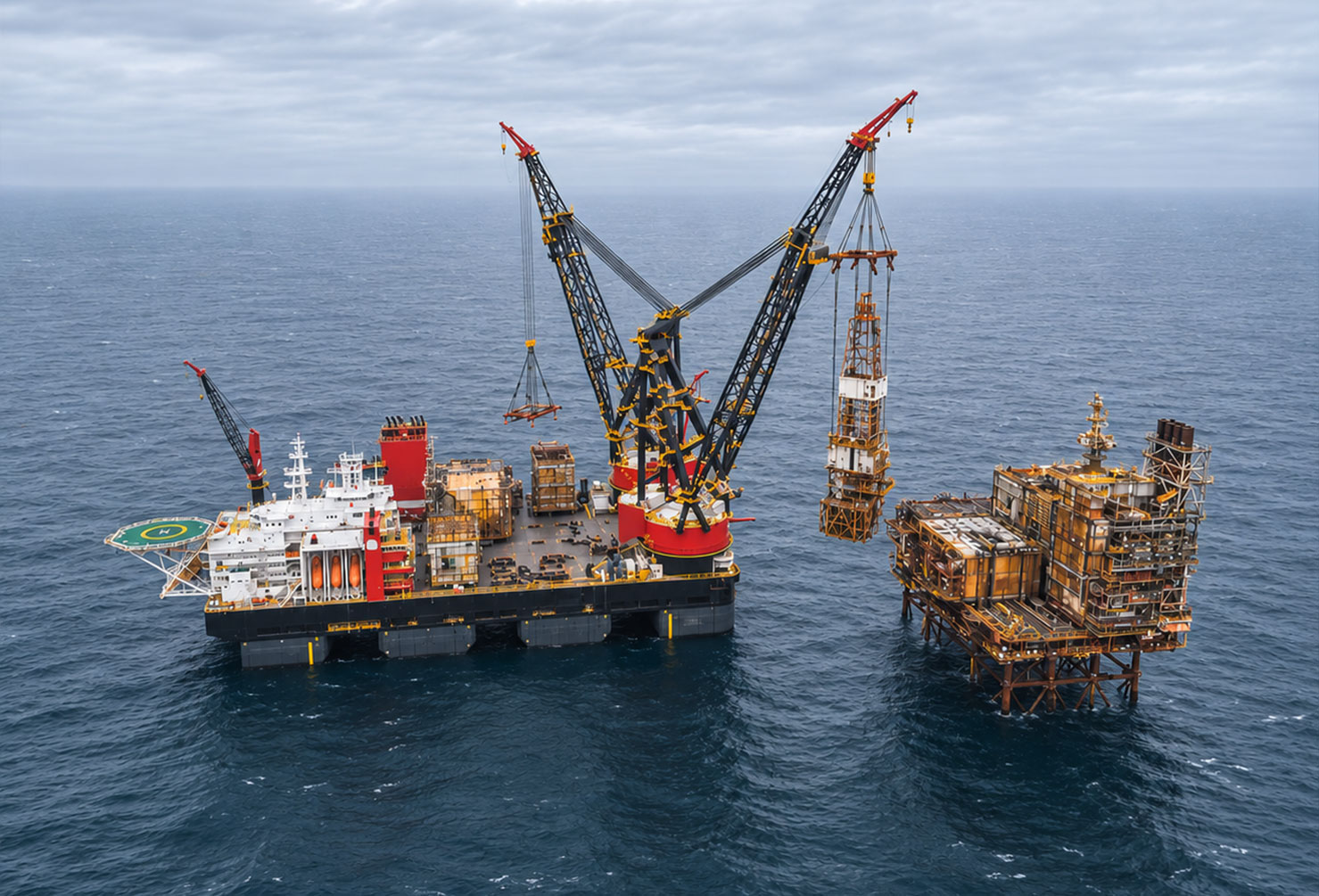
Australia is not standing still on volume, and it is worth being precise about that. In Bass Strait alone, more than 200 wells have been plugged and abandoned. Under the current programme, 134 were completed by the end of 2024, around 51 of them during 2024 itself. The Gippsland Basin Joint Venture, now operated by Woodside, is preparing to remove 13 platforms, with Allseas’ Pioneering Spirit contracted for the lift and work scheduled to begin from late 2026. More than $2 billion has already been spent. On raw activity, that is a programme the UK would recognise.
So the difference between the two markets is not effort, and it is not volume. It is what sits around the activity.
UK decommissioning is spread across many operators in a market with published cost and performance benchmarking, a regulator pushing those operators to pool vessels and data, and a domestic supply chain that captured 71% of contract value last year. Australian decommissioning is concentrated in a small number of very large, operator-led programmes, each solving its own problems.
That is a difference in market structure rather than in capability, and market structure is what determines who does the work and what it costs.
Lesson one: local content does not happen by itself
In 2025, 71% of the value of UK decommissioning contracts went to UK-based organisations.
That figure is the one Australian policymakers and operators should look at hardest, because it is not an accident and it is not guaranteed. It is the product of a supply chain that was deliberately built, in a market that had enough sustained volume to justify building it.
Modelling published in April by Redwater Insights, a policy research group that argues for faster government action on decommissioning, with economic analysis by Transition Economics, put numbers on what that difference is worth. Looking at UK offshore decommissioning across 2026 to 2035, it estimated around 11,300 direct full time equivalent jobs a year, and roughly 30,800 once indirect and induced employment is counted. How many of those roles sit in the UK rather than overseas depends on local content, and the study models that gap as running to thousands of jobs.
Those are modelled scenario outputs from a commissioned study rather than observed employment, and they should be read that way. But the direction they point is consistent with what the NSTA’s own contract data already shows.
The lesson transfers directly. The size of a decommissioning liability tells you how much will be spent. It tells you nothing about where that money lands, or who does the work. That is decided by whether a domestic supply chain exists when the work arrives, which is decided years earlier.
Lesson two: the binding constraint is equipment, and it is global
The UK market is running into a hard physical limit, and it is instructive.
The number of semi-submersible units marketed in the UK has fallen to six, down from a peak of eleven in 2023. The NSTA also reports a marked increase in the cost of large jacket and topside removals, those above 3,000 tonnes, driven by global demand for heavy lift vessels.
That last point matters enormously for Australia. Heavy lift vessels are a global fleet. When Australian operators come to remove topsides and jackets at scale, they will be bidding for the same vessels, in the same market, against operators in the North Sea, the Gulf of Mexico and Southeast Asia, all of whom are further up the queue and some of whom have been planning their slots for years.
Vessel availability is not a procurement detail to be resolved closer to the date. On a decommissioning programme it is the schedule.
Lesson three: campaigns beat one-offs, and sharing beats competing
The clearest cost lesson out of the UK is about how work is bundled.
The NSTA reports one operator saving more than £250,000 per well on an eight-well campaign. Not through new technology, but through doing eight of them in sequence with the same crew, the same equipment and the same learning curve.
The structural version of the same idea is now being formalised. In August, seventeen UK operators signed the NSTA’s Wellhead Severance Charter, committing to share data, expertise and resources, and to look for opportunities to use vessels jointly rather than each contracting separately. One of the specific opportunities identified is using vessels instead of rigs for final wellhead removal, which industry estimates suggest could cut remaining subsea wellhead removal costs by around 30%, or roughly £200 million.
Australia’s asset base is more dispersed and its operator set is smaller, so the mechanics would differ. The principle does not. Decommissioning rewards aggregation, and aggregation requires operators to cooperate in a way that competing for production never asked them to.
Lesson four: the jobs are real, and they are less secure than they look
This is the part of the UK experience that gets least attention and probably deserves the most.
The same Redwater modelling found that decommissioning roles are substantially skilled trades in which the UK already has shortages: welders, engineering technicians, crane operators, riggers and marine crew. It found the work has limited to moderate exposure to automation, because it is hands-on and depends on judgement. It also estimated that around 15,000 people leaving oil and gas production could have their careers extended by decommissioning work, and that roughly 5,500 decommissioning workers would still have ten or more years before average retirement age when the work winds down between the late 2030s and the mid 2040s. Those people will need somewhere to go next, which is a transition problem that has to be planned rather than assumed.
But it was blunt about the shape of the employment. Decommissioning jobs are frequently project-based, short to medium term, often agency or self-employed, with low union presence. The study identified that insecurity as a genuine risk, because it can push experienced people out of the sector before the work reaches its peak.
That finding deserves to be taken seriously rather than brushed past, including by those of us who work in contracting. A market that depends on specialist, project-based people has an obligation to think about continuity of work for those people, not just availability of them. The operators and contractors that get this right will have crews that stay. The ones that treat the workforce as a spot market will spend the 2030s rebuilding it repeatedly.
What Australia should take from this
Australia’s decommissioning profile has features the UK’s did not. Around 55% of the work falls before 2040, which is a steeper front end than the UK faced at the equivalent stage. It concentrates heavily in Western Australia, which holds 61% of the liability, with 23% off Victoria and 16% off the Northern Territory. And the inventory is substantial: more than 700 wells, around 7,600 kilometres of pipelines, 520 subsea structures and at least 2.7 million tonnes of infrastructure to be removed.
Three things follow from the UK experience.
- The domestic supply chain has to be built before the volume arrives, not in response to it. The UK’s 71% local content figure reflects decisions made years earlier.
- Vessel and specialist equipment access needs to be treated as a strategic constraint now, because Australia will be competing in a global market that is already tight.
- Capability needs to be aggregated. The gains in the UK have come from campaigns, shared data and joint vessel use, not from any single technical breakthrough.
None of these are engineering problems. They are planning and capability problems, which is why they tend to be addressed late.
The short version
The UK and Australia are looking at remaining decommissioning bills of a broadly similar size, and both are already spending. The difference is that the UK spends its through a market, with published benchmarking, a supply chain that captures most of the value and a regulator pushing operators to pool their resources.
Australia is doing the work through a handful of large programmes, with a steeper near-term profile and a smaller domestic supply chain to absorb what is coming. The work will happen either way. What is still open is how much of it is done by Australians, and whether the people who do it are still in the industry by the time it peaks.
Those are the questions worth asking now, because the North Sea has already shown what the answers cost when they are left until later.