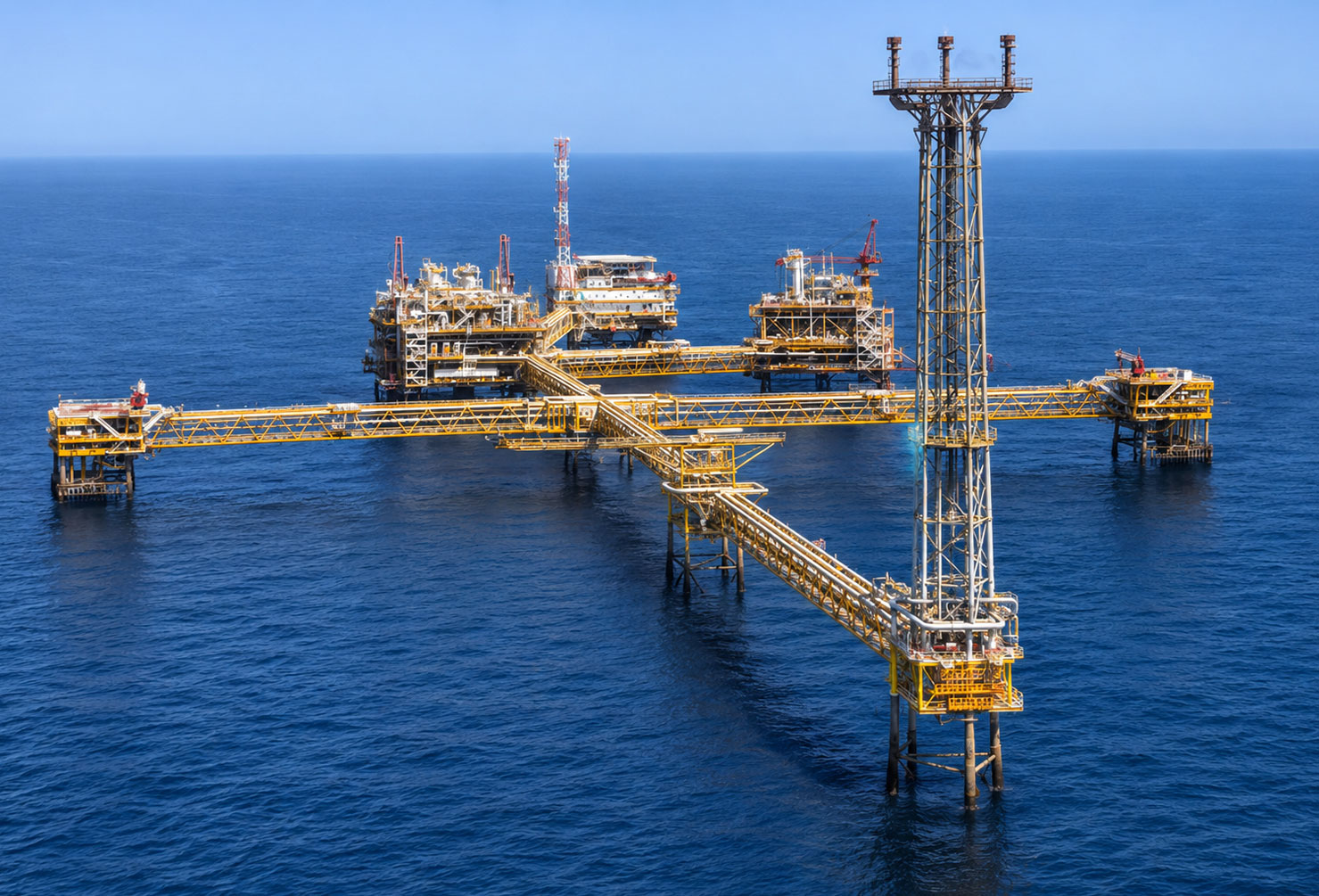
North Field East was around 85% complete when work on it stopped in March. It is fully funded. It is the centrepiece of what QatarEnergy described at sanction as the largest LNG project ever undertaken, four trains totalling 32 million tonnes a year.
Neither the money nor the construction progress got it finished. Nine months on, the first of its four trains was only being readied to run in November, with production guided to the first quarter of 2027. The remaining trains are expected through the rest of that year, and North Field South, two further trains, not until 2028.
The reason work stopped is a war, and that part of the story is not ours to comment on. It is worth saying plainly, though, that the human cost of it has fallen heavily on exactly the people this blog is usually about. By mid-November the International Maritime Organization had verified at least 130 attacks on commercial vessels across the region, with at least 25 seafarers killed. A tanker was struck in the Strait of Hormuz on 20 November. The Secretary-General’s words were that seafarers continue to lose their lives, suffer serious injuries, face abandonment and are denied repatriation. None of what follows is a comment on the conflict, or an argument that anybody should be pleased about the work it has created.
What is worth examining is narrower. A project this far advanced, with capital already committed, still took most of a year to get back towards starting. Understanding what filled that time is useful to anyone who runs projects, because suspensions happen for all sorts of reasons and the cost of them is consistently underestimated.
What stopping actually did
The conflict began on 28 February. QatarEnergy halted gas production at Ras Laffan and Mesaieed in early March after both were struck, and work on the North Field expansion stopped with it.
The practical sequence is the part worth noting. Most international marine insurers cancelled war risk cover for Gulf vessels. Offshore drilling and platform installation became impossible. Final subsea pipelay and platform commissioning halted. Non-essential personnel were evacuated from offshore rigs and construction barges.
So within weeks, a project at the most people-intensive stage of its life had lost its marine logistics, lost its ability to move equipment and stood down a large part of its offshore workforce, more or less at once.
What the operator says held it up
It would be easy, from a workforce business, to claim the people were the problem. The evidence does not support that as the headline and it is worth being accurate about it.
In September, chief executive Saad al-Kaabi tied the timing of the remaining trains to the Strait of Hormuz situation and pointed to delays in delivering the equipment the expansion needs. He also said Qatar is ready to resume normal operations within a few weeks of the Strait reopening, which sits alongside guidance putting the expansion trains in 2027 and 2028 rather than contradicting it.
The physical damage is a separate matter again. Two existing LNG trains at Ras Laffan, about 17% of Qatar’s production capacity, were damaged and are reported to need around three years of repair. The Pearl gas to liquids facility has partially restarted, with its damaged second train expected back in the first quarter of 2027.
So the honest reading is that a suspension creates several constraints at once and they compound. Equipment deliveries stop. Marine logistics stop. Insurance is withdrawn. Physical damage has to be assessed and repaired. And the workforce stands down.
The first four are visible. They get owned by somebody, costed, and reported on. The fifth is the one that tends to be assumed away, and it is the one with the longest tail.
Why starting again is harder than stopping
Standing a project workforce down takes days. Reassembling one takes considerably longer, and the reasons are structural rather than administrative.
Start with where these people come from. Specialist commissioning and offshore supervisory roles on a project of this scale are filled from an international contractor pool rather than locally. Commissioning engineers, instrument and control technicians, rotating equipment specialists and offshore supervisors move between projects and between countries. That is precisely why access restrictions bite so hard: when the people cannot travel, or the insurance will not cover the vessel that would carry them, the pool that the project depends on becomes unreachable.
They also do not wait. When a project suspends with no restart date, specialists take the next engagement. By the time it restarts they are well into something else, often on another continent, and extracting them means waiting for that commitment to end.
Knowledge leaves with them. On a project at 85% completion a great deal of what matters is not in the documentation. It is in the heads of the people who built it: what was changed in the field and why, which systems behaved oddly during pre-commissioning, which vendor interfaces were difficult. A new team can rebuild that understanding, but it takes time, and it is the most expensive kind of time because it happens on the critical path.
And the restart competes with everything else. A project that suspends does not get to restart into the market it left. It reassembles into whatever market exists on the day, bidding for the same people as every other project that happens to be live. Rystad Energy’s assessment of the broader Gulf repair workload made a version of this point, concluding that access to equipment, contractors and logistics rather than capital is the key limiting factor, with engineering and construction accounting for the largest share of expected spending.
What this looks like from Australia
Two parts of this are already relevant here.
The first is the global pool. Heavy lift vessels, semi-submersibles, specialist subsea crews and commissioning teams move between regions according to where the work is. The North Sea Transition Authority has reported only six semi-submersible units marketed in the UK, down from a peak of eleven in 2023, along with a marked increase in the cost of large removals above three thousand tonnes driven by increased global demand for heavy lift vessels. Australian operators planning decommissioning and brownfield campaigns are drawing on that same pool, and so will the Gulf as its work ramps back up.
The second is closer to home. Australia currently has several appraisal and development campaigns running or about to start, across the Taroom Trough, offshore Victoria and Western Australia, operated by companies of very different sizes and sharing an overlapping group of rigs and service contractors. Any one of those that pauses faces a smaller version of the same question: whether the crew it releases will be there when it wants them back.
There is a commercial dimension too, though it belongs to the traders rather than to us. With around 17% of Qatari capacity out for roughly three years and a 32 million tonne expansion arriving later than planned, the supply picture Australian LNG sells into looks different from the one anyone modelled in 2025.
What actually helps
There is no clever answer to a project stopped by events outside anyone’s control. There are, though, a few things that consistently separate projects that restart well from projects that restart slowly.
- Knowing who you actually need. Not a headcount by discipline, but the specific people and the specific knowledge that would be expensive to lose. On most projects that list is shorter than expected and nobody has written it down.
- Keeping a thread to the key people. A suspended project has no work to offer, but it can stay in contact, be honest about timing, and be the first call when there is news. Specialists remember who did that and who went silent.
- Treating remobilisation as a scope rather than an event. The assumption that a restart is simply the reverse of a shutdown is where most of the lost time comes from.
- Capturing what is in people’s heads before they leave, not after. This is the cheapest insurance available on a suspended project and it is almost always skipped, because at the point of suspension everybody is busy demobilising.
The short version
Being 85% built and fully funded did not finish North Field East, and neither of those things was ever going to. A suspension is not one problem. It is equipment, logistics, insurance, damage and people, and they arrive together.
Four of those five get owned by somebody. The workforce one usually does not, which is why it is the one still being paid for long after the others are resolved.
Stopping is a decision. Starting again is several problems at once, and the one nobody owns is the people.