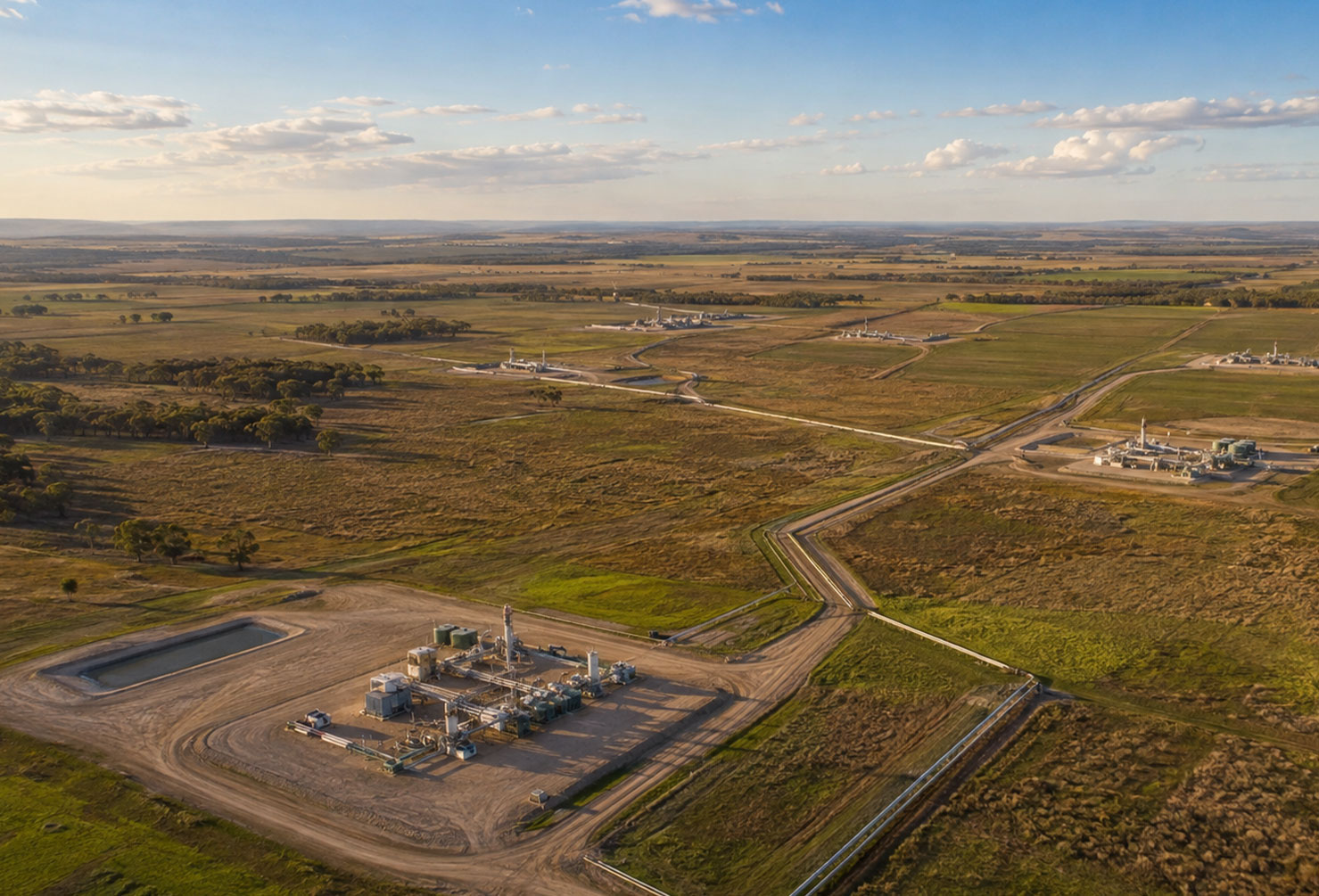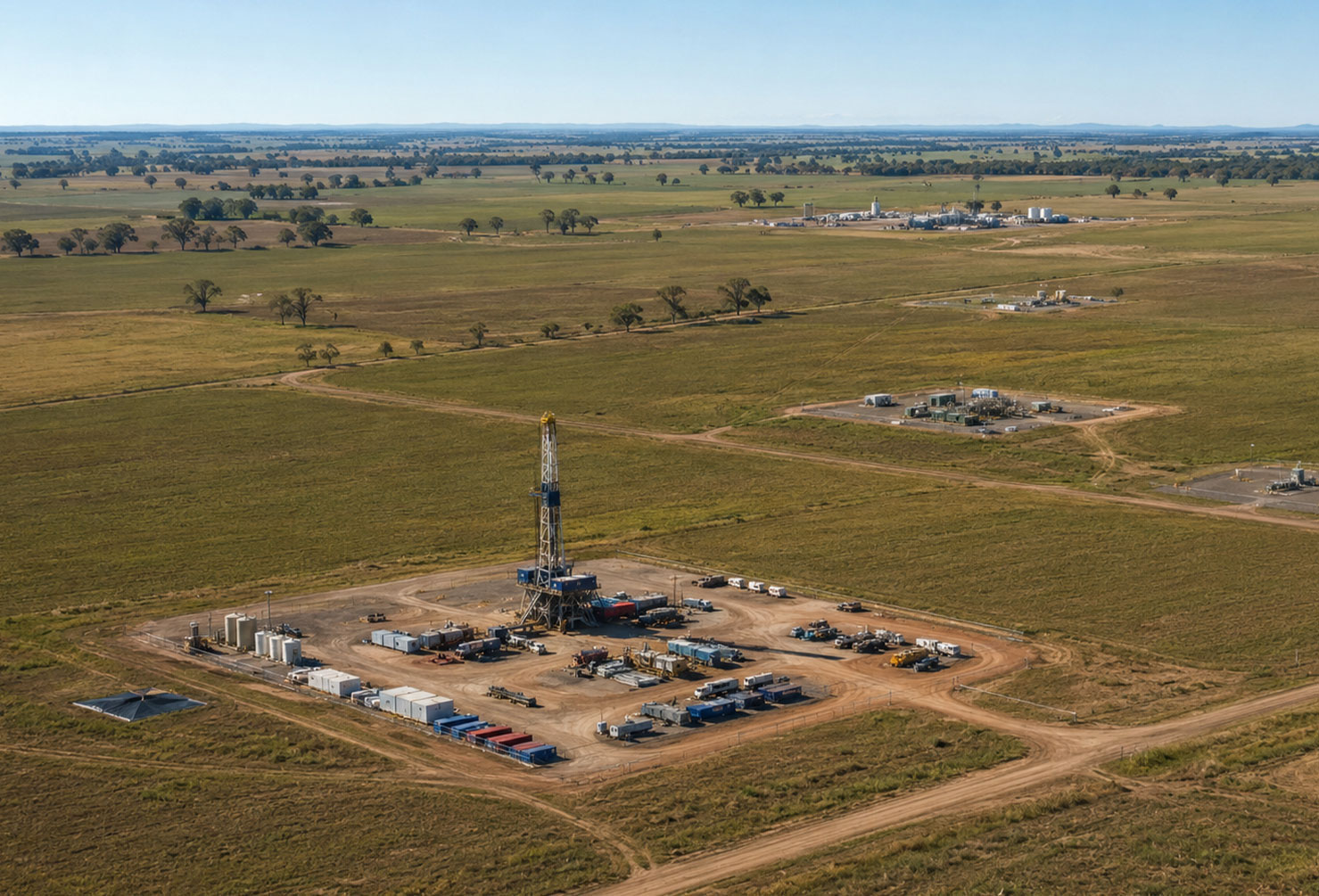
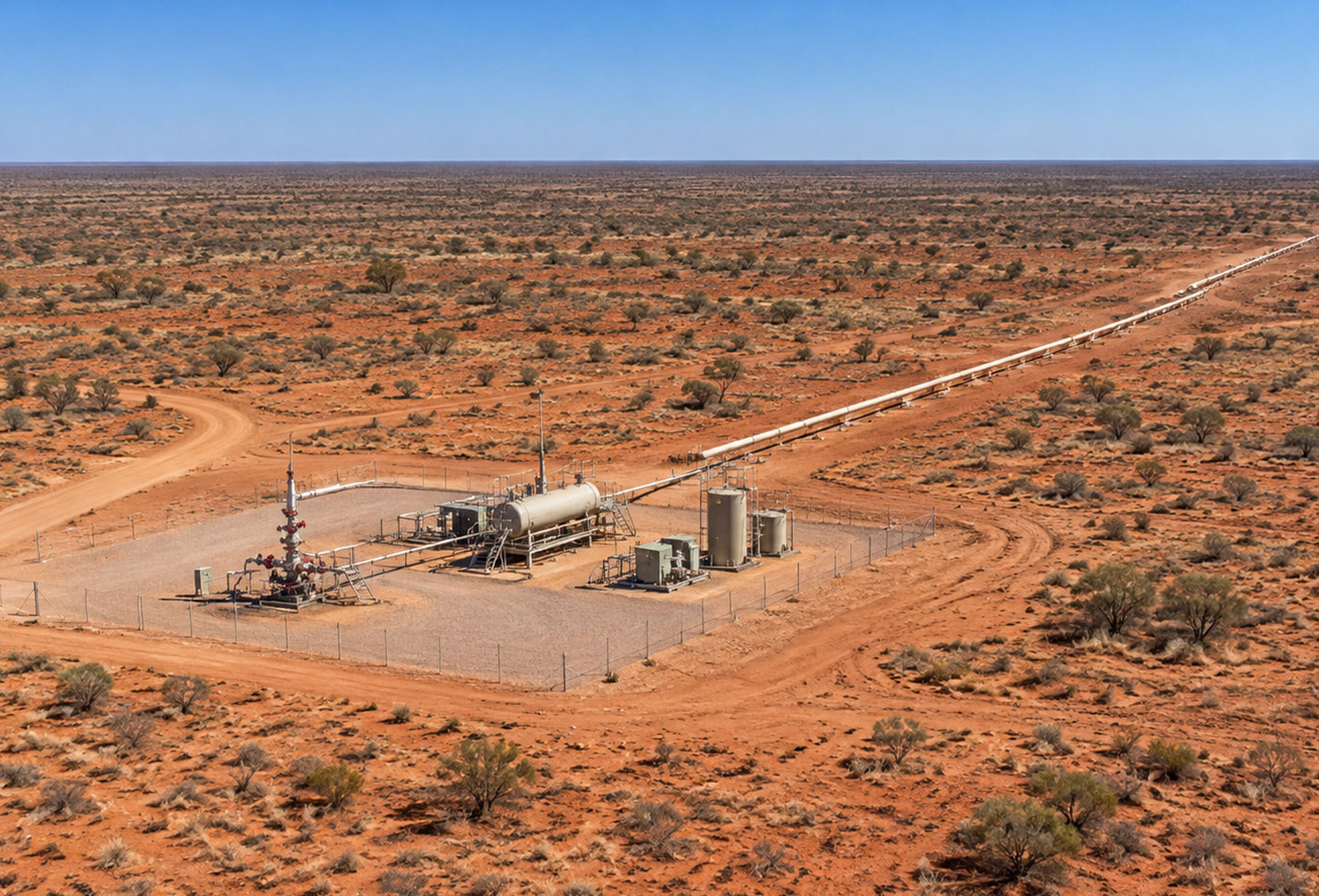
Santos-operated Rig 184 spudded the Yarrow 5 development well on the evening of 8 September 2026, moving directly from Yarrow 4 to Yarrow 5 on the same dual well pad within PRL 17 at the Innamincka Dome in South Australia’s Cooper Basin. The decision to drill two wells from a single pad is deliberate and economical: it keeps development costs down and shortens the path to production, as Red Sky Energy Managing Director and CEO Andrew Knox noted in the company’s ASX announcement.
The Cooper Basin is one of Australia’s most important conventional gas provinces and one of its longest-producing. Gas has been flowing from Cooper Basin fields to the south-east via the Moomba-Adelaide Pipeline since November 1969, making it a foundational piece of Australian energy infrastructure. The Yarrow development program is not a headline project. It is a well-executed, infrastructure-leveraged development program of the kind that keeps a mature basin productive — and it illustrates something important about how the Australian upstream works in 2026.
What the Yarrow Field Is and Where It Sits
The Yarrow gas field sits within PRL 17 at the Innamincka Dome, a proven producing structure in South Australia’s Cooper Basin. Red Sky Energy holds a 20% working interest across six petroleum retention licences — PRL 14, 17, 18, 180, 181 and 182 — within the Santos-operated Innamincka Dome Joint Venture. Santos is the operator. The primary reservoir targets are the Permian Patchawarra and Tirrawarra sandstones, tight formations that require hydraulic fracture stimulation to produce at commercial rates.
Yarrow 1 and Yarrow 3 are already producing. Yarrow 1 was tied in and commissioned in November 2025, flowing into Santos’s Cooper Basin gas gathering network connected directly to the Moomba facility. Moomba is the hub of Santos’s east Australian gas processing and pipeline infrastructure, connecting Cooper Basin production to both the east coast domestic gas market via the Moomba to Sydney Pipeline and to other markets via the Moomba to Adelaide Pipeline. Yarrow production enters an established, operational system rather than requiring standalone infrastructure.
What the Yarrow Wells Involve
The current Yarrow drilling campaign consists of two development wells from a shared pad — Yarrow 4 and Yarrow 5 — with a potential third well, Yarrow North 1, subject to a JV vote and supplementary budget approval before it can proceed.
Yarrow 4 reached a total depth of 2,908 metres on 6 September 2026. It is a modest but workable result: preliminary interpretation of logging while drilling data identified two gas-saturated zones within the Tirrawarra Sandstone, with 5.2 metres of low deliverability gas pay, plus an additional 0.2 metres of low deliverability gas pay in the Patchawarra Formation. A downhole formation pressure survey recorded approximately 3,335 psi in the Tirrawarra reservoir section. Santos recommended casing and suspending the well as a future gas producer, with a workover rig to return for hydraulic fracture stimulation and completion. The result is not a barn-burner — low deliverability pay means the reservoir requires stimulation to produce — but it confirms the well has reached its target and can be completed for production.
Yarrow 5 spudded on the evening of 8 September 2026 from the same dual well pad. The well is planned to a total depth of approximately 2,775 metres, with a similar design to Yarrow 4 targeting the same Permian sandstone reservoirs. Total depth was expected by around 14 September 2026, subject to operational conditions.
Yarrow North 1 is a planned re-entry of an existing wellbore initially drilled as an exploration well in March 2008 and cased and suspended without ever producing gas. The JV intends to re-enter the existing wellbore, perforate the Tirrawarra Sandstone and hydraulically stimulate it using a single-stage fracture. If approved, approximately 950 metres of new flowline and pipeline would connect Yarrow North 1 to the existing Yarrow 1 flowline and into the Santos gathering network. Red Sky’s September 2026 ASX announcement is explicit that the Yarrow North 1 re-entry sits outside the currently approved JV budget and requires both supplementary budget approval and a JV vote before it can proceed. The early 2027 first gas target is expressly conditional on that approval being obtained. It has not yet been confirmed.
Why Dual Well Pads and Well Re-Entries Are Worth Understanding
The mechanics of the Yarrow program illustrate a development philosophy that is particularly relevant in a mature basin environment: minimise incremental capital per unit of production by leveraging existing assets and shared infrastructure wherever possible.
Drilling two wells from a single pad reduces rig mobilisation costs, eliminates separate civil works for each well site, and compresses the total program timeline. In a remote Cooper Basin environment where access roads, site preparation and wet weather delays are material variables, these savings are significant. Santos’s decision to move Rig 184 directly from Yarrow 4 to Yarrow 5 without demobilisation is the simplest possible expression of that logic.
The Yarrow North 1 re-entry, if it proceeds, is an even more capital-efficient approach. Red Sky’s operator estimates put the gross cost at approximately A$2.98 million, with Red Sky’s 20% share at roughly A$0.60 million. Estimated gross incremental raw gas is approximately 0.52 billion cubic feet at an initial rate of 2.1 million standard cubic feet per day. Those figures are operator estimates and Red Sky is not booking them as reserves, so they carry the appropriate uncertainty of pre-completion projections. But even at that scale, the economics of re-entering an existing wellbore rather than drilling a new one to the same depth are materially favourable. The wellbore infrastructure is already in the ground. The subsurface penetration has already been made. What remains is the completion work.
The Infrastructure That Makes It All Work
The Yarrow development would not be commercially viable without the Santos-operated infrastructure that surrounds it. This is the defining characteristic of the Cooper Basin as a development environment and what distinguishes it from exploration-stage basins.
Santos operates an extensive network of gas gathering pipelines, compression stations and processing facilities across the Cooper Basin. The Moomba facility at the heart of that network has been processing Cooper Basin gas since the late 1960s and distributes it through pipelines connecting to both the east coast domestic gas market and South Australia. Production from a new Yarrow well enters the same gathering system that has been operating for over 50 years.
For Red Sky as a 20% JV partner, this infrastructure is what makes the commercial model work at a scale that would not be viable in a frontier basin requiring standalone infrastructure. The cost of bringing a new Yarrow well into production is the cost of drilling, stimulating and connecting the well to the existing flowline network — not the cost of building a gas plant, a trunk pipeline or a market connection.
What Else Is Coming at the Innamincka Dome
The Yarrow two-well pad campaign is not the complete picture of Red Sky’s current activity at the Innamincka Dome. The company has also received access approvals for the Willowie 2 appraisal well within PRL 18, a separate AFE from the Yarrow program, with civil works expected to commence in early September 2026 and spud anticipated in late October 2026.
Willowie 2 targets the same Patchawarra and Tirrawarra formations as the Yarrow field and lies within the same structural trend. A successful Willowie 2 result would extend the producible footprint of the Innamincka Dome and could add further resource to the Santos gathering network. It also means the Innamincka Dome drilling activity will continue beyond the current Yarrow pad campaign — the Willowie 2 result is worth watching as the next milestone from the same program.
The Workforce the Cooper Basin Requires
The Yarrow development program draws on a specific workforce that is distinct from the offshore engineering workforce of WA LNG and the shale development workforce emerging in the Beetaloo Basin.
Onshore development drilling in the Cooper Basin requires rig crews with experience in the Permian Patchawarra and Tirrawarra sandstone formations. Well depths of 2,700 to 3,000 metres in remote outback South Australia require drillers, toolpushers, derrickmen and mud engineers who understand the specific drilling characteristics of these formations and who can operate effectively in the logistically demanding environment of remote outback access with weather-dependent road conditions.
Hydraulic fracture stimulation of tight Permian sandstones is a specialised completions discipline. The stimulation required to bring Yarrow 4 into production, and the single-stage frac planned for Yarrow North 1 if it proceeds, requires completions engineers who understand the specific rock mechanics, fluid systems and pressure management of these reservoirs. Cooper Basin frac experience is distinct from both Surat Basin CSG stimulation and Beetaloo Basin shale stimulation.
Pipeline and flowline construction in the Cooper Basin requires civil and pipeline trades who can work in remote SA outback conditions. The 950 metres of new flowline planned for Yarrow North 1 is a small project by most measures, but in the Cooper Basin context it requires the logistical planning and pastoral access management that remote outback pipeline work always demands.
The operational workforce that manages Yarrow production into the Santos gathering system is the long-duration employment layer. Production technicians and instrument and electrical maintenance professionals working across the Cooper Basin network will look after Yarrow production for years after the drilling crews have moved on.
What the Cooper Basin Story Tells Us About Australian Upstream in 2026
The Yarrow development is a small program. Three wells if Yarrow North 1 is approved, two if it is not. One small-cap operator with a 20% interest, a major partner with established infrastructure. It will not generate the headlines that Scarborough’s first LNG cargo or the Beetaloo Basin’s first gas attracted this week. But it represents something durable about how the Australian upstream works.
Mature basins like the Cooper do not produce headlines. They produce gas. Continuously, reliably, from a network of fields and wells that has been operating for over 50 years. The development economics that keep those fields productive — dual-pad drilling, well re-entries, infrastructure integration — are not glamorous. They are effective.
For the east coast gas market, the contribution of Yarrow and the many Cooper Basin development wells drilled without fanfare each year is real and cumulative. AEMO has identified a peak-day shortfall risk for the east coast domestic market from around 2029, recently pushed back by one year. Each new well that connects to the Santos gathering network and flows gas to Moomba adds to the supply picture for that window. In a market where supply increments matter, the quiet development work of the Cooper Basin is more important than it appears from the outside.
For workers with Cooper Basin experience, the Yarrow program is a reminder that Australia’s longest-producing gas province is still active. The specific skills it needs — remote outback drilling, tight Permian sandstone completions, Cooper Basin infrastructure operations — are not widely held. For those who have them, the demand is consistent.