
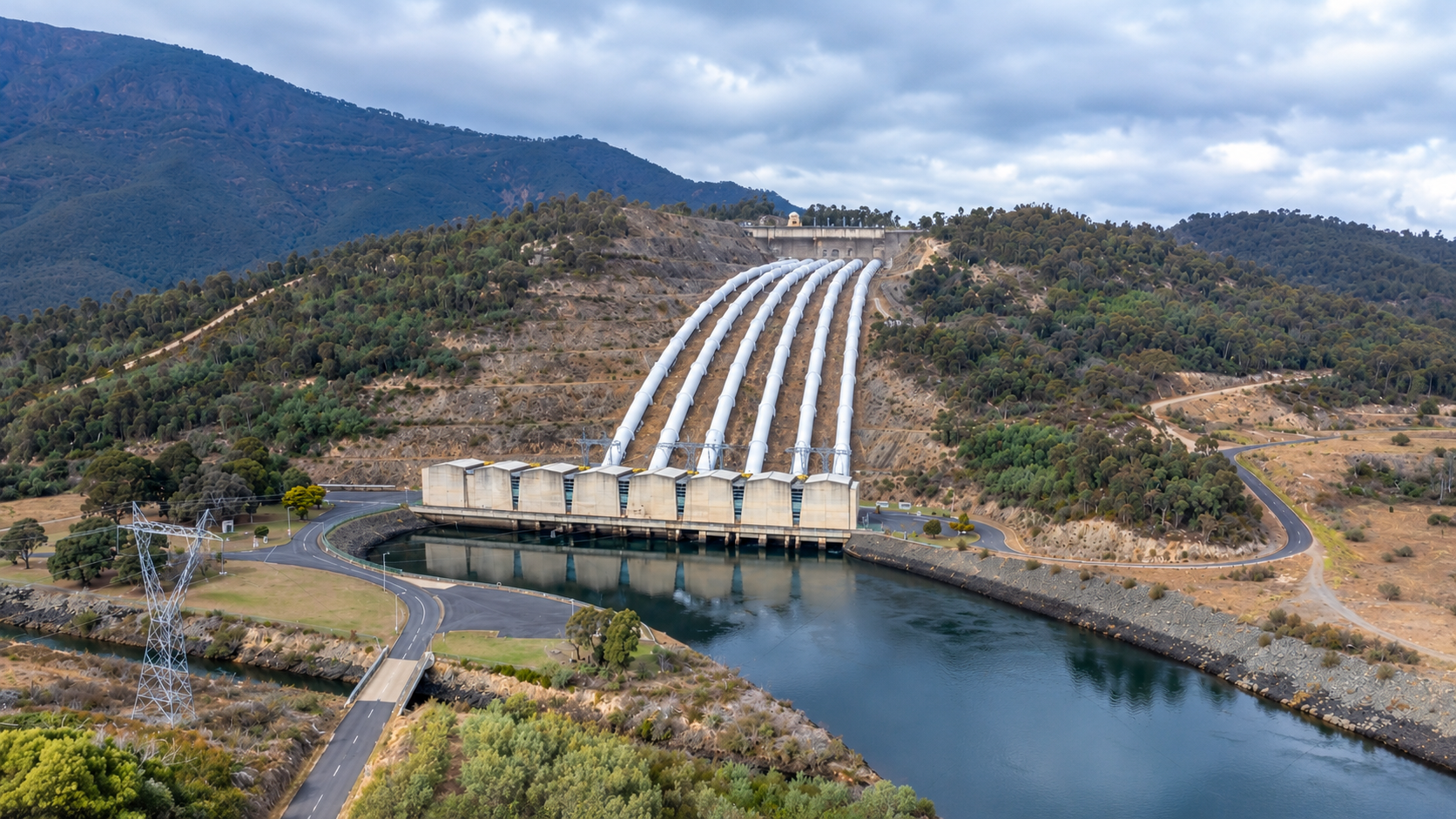
Snowy Hydro released its long-awaited cost reassessment for Snowy 2.0 on 22 October. The project now carries a target cost of around $22 billion with a further $3 billion allowance, giving a ceiling of $25 billion. First power has moved to early 2029 with full operation later that year. The original 2017 figure was $2 billion for a scheme that was to be operating by 2021.
Most of the coverage has focused on the number, on who is responsible, and on the political argument that followed. That is understandable and it is not what this piece is about.
What is worth the attention of anyone running a capital programme is a single sentence from Snowy Hydro chief executive Dennis Barnes, explaining what drove the revision: “We’ve understood that we’re going to need a lot more people for a lot longer to deliver this job. This job is 80 per cent people costs. We’ve got 5,000 people on the job now working across multiple work fronts and that’s obviously a lot more than we thought in 2023.”
It is rare for a project of this size to state the workforce problem that plainly. It is worth taking seriously, because the dynamics behind it are not specific to pumped hydro and they are entirely familiar to anyone who has delivered a major upstream project.
What the Numbers Actually Say
The cost history is worth setting out properly, because the headline figure compresses several different estimates made at very different stages of design maturity.
The project was announced in early 2017 at around $2 billion, before a business case had been completed. A feasibility study released in December that year put it at $3.8 billion to $4.5 billion. The 2023 reset, which followed a contractual restructure with the principal contractor, set it at $12 billion with first power targeted for late 2027. The current reassessment puts the target at around $22 billion with a $3 billion allowance on top.
At the same time, the physical progress is real. Design completion has moved from 44% at the 2023 reset to 96% now. Machine tunnelling is 65% complete and cavern excavation is 90% complete, with construction of the underground power station underway. Barnes has described the project as being in its strongest position yet while saying he is incredibly disappointed by the cost that progress has carried.
Those two facts sitting together are the interesting part. Progress accelerated and cost rose at the same time. That combination is not a contradiction and it is not unusual. It is what happens when a project discovers what it actually involves.
What an 80% Labour Share Actually Means
On most capital projects the cost conversation centres on equipment, materials and contractor margin. Labour is present in the estimate but it is rarely the dominant line.
On a project where labour is 80% of cost, every other assumption becomes secondary. The accuracy of the total estimate is almost entirely a function of two numbers: how many people are needed, and for how long. Get either wrong and the error does not sit in a corner of the budget. It is the budget.
The question that raises for upstream is a simple one that is worth answering with real numbers rather than assumption: what is the labour share on your own programmes? It will differ by scope. A greenfield build carrying significant equipment and module cost sits in one place. A commissioning programme, a major shutdown or a brownfield modification campaign, where the scope is largely people working on an asset that already exists, will sit somewhere else. Few operators can state that figure for their own portfolio, and it determines how much of the total estimate rests on workforce assumptions.
Design Maturity and the Workforce Estimate
Barnes attributed a significant part of the revision to design immaturity before the 2023 reset. The principal contractor made a similar point in its submission to the parliamentary inquiry, noting the project began at a time of early design maturation, based on an evolving design and engineering methodology in which assumptions had to be tested and solutions developed as actual conditions were encountered.
Strip out the contractual context and what remains is a straightforward engineering reality. A workforce estimate is downstream of a design. If the design is 44% mature, the workforce estimate built on it is an estimate of a project that does not yet fully exist. Every subsequent design development carries a workforce consequence, and those consequences almost never run in the direction of needing fewer people.
The parallel in upstream is the gap between concept select and FID. A workforce plan built on a pre-FEED concept is a different document from one built on a completed FEED, and the difference is not detail. It is scale. Operators who sanction on a workforce estimate drawn from an immature design are accepting a risk that will surface during execution, when it is most expensive to correct.
None of which makes early estimates useless. It makes the maturity of the design behind them something that should be stated explicitly rather than assumed.
The Duration Problem
The phrase worth sitting with in Barnes’ comment is “a lot more people for a lot longer.” Two variables, both moving, and they multiply.
Headcount growth on its own is manageable. Schedule extension on its own is manageable. The combination is what produces step changes in cost, because the additional people are carried across the additional duration. A 20% increase in headcount across a 20% longer programme is not a 40% increase in labour cost. It is closer to 44%, before any escalation is applied.
Long-duration programmes also expose a project to labour market movement in a way that short ones do not. The principal contractor’s submission made this point directly: the 2023 reset included a mechanism for annual escalation, but actual cost escalation experienced on the project far exceeded what that mechanism provided for.
That is a specific and transferable warning, and it is the contractor’s own account rather than an outside interpretation. Whatever escalation assumption was built into the reset, the labour market moved further. The transferable question for any operator with a multi-year execution window is whether the escalation assumption in their own contracts was set against general cost movement or against the actual market for the specific disciplines the programme depends on. Those are not the same thing, and in a constrained market for specialist skills they can diverge considerably.
Concurrency Multiplies the Planning Problem
One detail in Barnes’ comment is easy to pass over: 5,000 people working across multiple work fronts.
Concurrent work fronts are often the right answer to a schedule problem. They are also substantially harder to resource than sequential ones. The same specialist disciplines are required in more than one place at the same time, interfaces multiply, and the planning assumption that a crew finishing one scope can move to the next stops holding.
This is a familiar problem in upstream. A commissioning programme running offshore and onshore simultaneously, or a turnaround overlapping with a brownfield modification, creates exactly this dynamic. The workforce requirement is not the sum of the individual scopes. It is higher, because the sequencing flexibility that would otherwise let people move between them has been removed.
What Operators Should Take From This
Four things, none of which require a view on who is responsible for what at Snowy.
First, know your labour share. If people are 80% of cost, workforce planning is not a supporting activity within project controls. It is the primary cost discipline and it should be resourced accordingly.
Second, state the design maturity behind any workforce estimate. An estimate drawn from a 40% design and an estimate drawn from a completed FEED should not be presented in the same format or carry the same confidence. Treating them as equivalent is how a number that was always provisional ends up being treated as a commitment.
Third, model headcount and duration together. They compound, and most estimating practice handles them separately.
Fourth, test escalation against the specific market. The disciplines that constrain a programme are rarely the ones a general index tracks. Commissioning engineers, specialist completions personnel and subsea controls engineers do not price like general construction labour, and in a tight market they do not move like it either.
Why This Is Worth Reading From Inside Oil and Gas
Snowy 2.0 is a pumped hydro scheme and the rock it is tunnelling through has nothing to do with upstream. The temptation is to file it under renewables and move on.
That would be a mistake, for a straightforward reason. It is unusual for a megaproject to publicly attribute a cost revision substantially to getting its workforce assumptions wrong. Most projects that experience the same problem describe it as scope growth, productivity, ground conditions or contractor performance. Those explanations are often true as far as they go, and they also tend to obscure the labour dynamics underneath.
Barnes has been more direct than that, and the result is a rare piece of public evidence about something the industry generally discusses privately. The next wave of Australian energy projects, across LNG backfill, pipeline construction, unconventional development and offshore CCS, will all be executed over multi-year windows in a labour market where specialist disciplines are already stretched. The lesson is available now, from a project that has already paid for it.