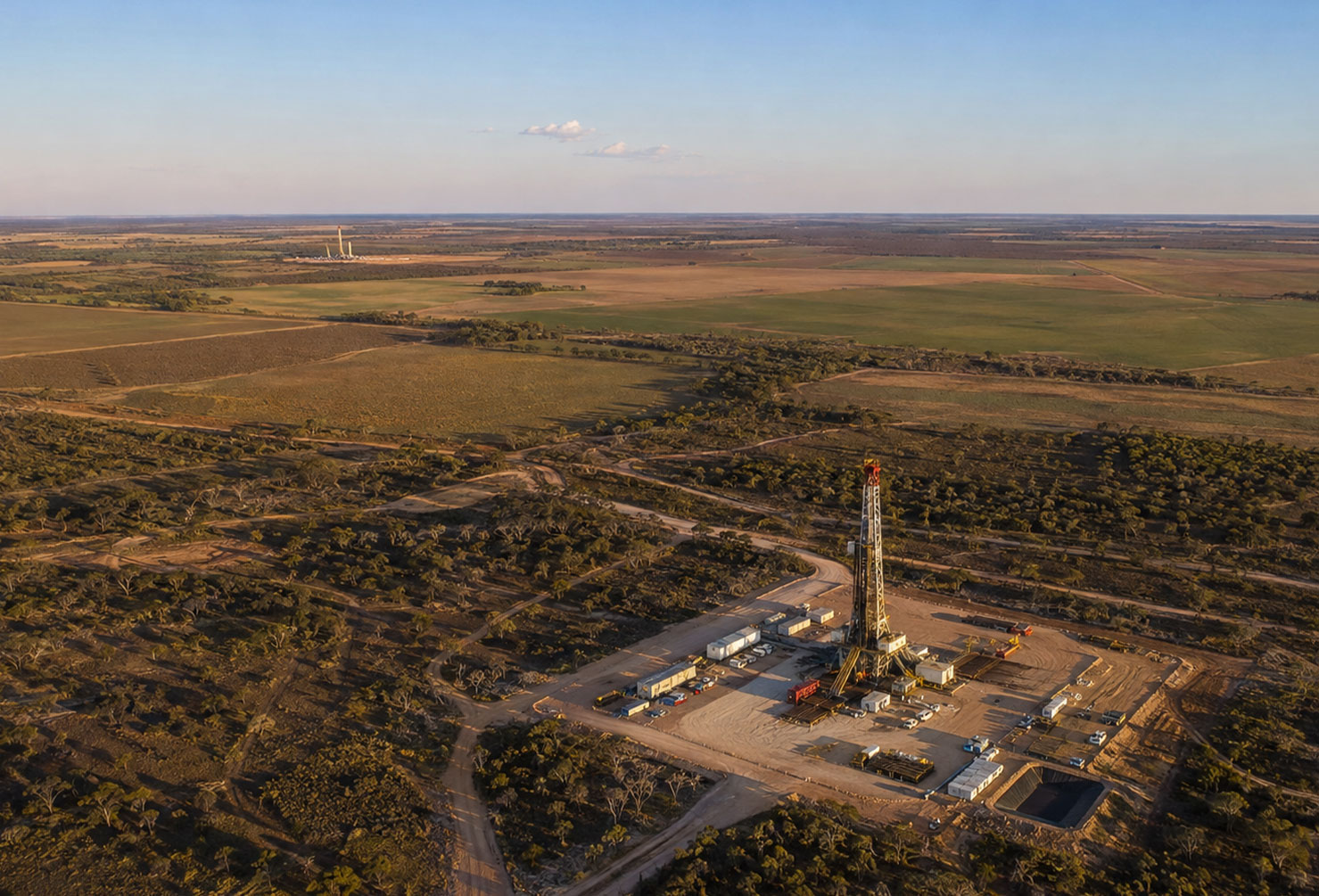
The Taroom Trough has been one of the most active exploration stories in Australian oil and gas for the past 12 months. Shell running Queensland’s largest-ever 3D seismic survey. Elixir Energy’s Lorelle-3H well achieving sustained gas flow. Multiple operators drilling simultaneously across the Western Downs. The case that Queensland’s deep Permian play could be a major new Australian oil and gas province has been building well by well.
Omega Oil and Gas released results from Canyon-3 on 25 August 2026, the first well in its 2026-27 appraisal program. The well reached total depth of 3,792.6 metres on 15 August and delivered results that, in the words of CEO Trevor Brown, exceeded pre-drill expectations. The Canyon-3 data is not just another positive well result. It changes the scale of the Taroom Trough story in ways that operators, investors and the workforce need to understand.
What Canyon-3 Actually Found
Canyon-3 was drilled approximately 9 to 10 kilometres southeast and 275 metres updip of Canyon-1, in the eastern Taroom Trough within Queensland’s south Bowen Basin. The objective was to evaluate the lateral extent and continuity of the stacked Permian reservoir intervals, and to test the hydrocarbon distribution updip from the original Canyon discovery.
The well confirmed a 526-metre thick oil and gas-bearing Permian interval with 170 metres of aggregate net pay across six regionally correlatable reservoirs. The headline numbers from the primary Canyon Sandstone target are significant: 18 metres of net oil-bearing sands at 11.5% average porosity within a 42-metre gross reservoir interval. Those numbers represent a 14% thickness increase and a 55% improvement in porosity compared to the equivalent interval in Canyon-1. Better reservoir quality, further from the original discovery well, in the updip direction toward the Cabawin oil field.
Six reservoir layers were confirmed as regionally correlated, including a newly identified sixth layer, the Lower Kianga Sandstone immediately above the Canyon Sandstone. Oil fluorescence observed in drill cuttings across all six reservoirs provided visual hydrocarbon evidence throughout the Permian sequence. Advanced surface logging technology confirmed hydrocarbon shows through the well.
Why the Scale Confirmation Matters
The most consequential aspect of the Canyon-3 result is not the individual well data. It is what the well tells us about the geographic extent of the Canyon reservoir system.
Canyon-3 results indicate that the Canyon Sandstone extends at least 20 kilometres east-west from Canyon-1 through Canyon-3 in the direction of the Cabawin oil field. Regional well data indicates continuity of the Canyon Sandstone for more than 40 kilometres north-south from Canyon-2 to Tasmania-1 within ATP 2081, and then over a further 40 kilometres northwest toward Fantome-1. That is a reservoir system with demonstrated continuity across more than 80 kilometres north-south and at least 20 kilometres east-west, covering an area of more than 200 square kilometres between the existing Canyon wells and the Cabawin oil field — the currently-demonstrated extension area within Omega’s much larger approximately 1,800 square kilometre operated acreage position in the eastern Taroom Trough.
To put that in context: SLB modelling of a single Canyon Sandstone reservoir layer indicates a 10-year estimated ultimate recovery of approximately 0.95 million barrels of oil equivalent, or around 5.72 billion cubic feet of gas equivalent, from a single 2,000-metre horizontal development well at 1,000-metre well spacing. Across a 200-square-kilometre area with six reservoir layers and multiple horizontal development wells, the resource potential of the eastern Taroom Trough is beginning to look very large indeed.
The contingent resource booked from Omega’s initial Canyon drilling program ranged from 0.4 to 4.5 trillion cubic feet equivalent across the 1C to 3C range. Canyon-3, combined with the Canyon-4 results that are now being drilled, will feed into an updated resource and reserve assessment expected in late 2026. That assessment is likely to be materially larger than the current contingent resource estimate.
Where the Taroom Trough Sits in the Broader Context
Canyon-3 is one data point in a basin that now has multiple operators delivering positive results simultaneously. The Taroom Trough in August 2026 looks like this:
- Shell has completed the largest 3D seismic survey ever undertaken in Queensland, covering its acreage across the western flank of the basin. That dataset is being processed and will inform Shell’s development planning.
- Elixir Energy’s Lorelle-3H well achieved sustained gas flow from 29 June 2026, the first horizontal well tested outside Shell’s primary acreage. The well intersected 148 metres of net gas-condensate pay across four Permian reservoirs and confirmed the western flank play.
- Omega’s Canyon-3 has now confirmed the eastern flank play at a scale that exceeds pre-drill expectations, with Canyon-4 drilling underway and two further vertical wells plus one or two horizontal flow tests to follow in the 2026-27 program.
- Santos holds operated interests in the basin alongside its JV with Elixir and its own acreage, and is expected to take operatorship of the ATP2056 permit as appraisal progresses.
Multiple operators drilling simultaneously across both the eastern and western flanks of the same basin, all delivering positive results, is a pattern that the Australian upstream industry has not seen in Queensland’s conventional and unconventional gas sector in a generation. The Queensland Government’s acknowledgement of the Taroom Trough as potentially Australia’s first major new oil province since the 1970s, and its $11.9 million commitment to a Taroom Trough Development Plan in the 2026-27 Budget, reflects how seriously both industry and government are treating the basin’s potential.
What This Means for the Workforce
Canyon-3’s scale confirmation accelerates the timeline toward a development decision in a way that the earlier appraisal results had not yet achieved. The transition from exploration and appraisal to development planning requires a different set of specialist skills and a different workforce engagement model.
The appraisal phase currently underway across the Taroom Trough is generating sustained demand for:
- Drilling engineers with deep onshore unconventional experience, specifically those familiar with Permian sandstone targets and horizontal well design in tight reservoir settings.
- Wellsite geologists and petrophysicists for real-time formation evaluation, formation sampling and net pay analysis during vertical and horizontal drilling programs.
- Completions engineers with multi-stage hydraulic fracture stimulation experience for the horizontal flow tests that follow the vertical appraisal wells in Omega’s 2026-27 program.
- Reservoir engineers and geoscientists for the resource and reserve assessment work that will be completed in late 2026 across multiple operator datasets simultaneously.
As the basin transitions toward development planning, a second wave of specialist demand follows. Development engineers will be needed to convert appraisal data into well designs, facility layouts and infrastructure plans. Environmental and heritage consultants will be required for the development application processes that follow positive appraisal results. Project development managers with experience in Queensland’s onshore regulatory environment will be needed to manage the approvals and contracting processes for what could become a multi-decade development program.
The updated resource and reserve assessment expected from Omega in late 2026 will be a material inflection point. If the assessed resources at that point support a development decision, the workforce implications shift from the specialist appraisal pool to a much larger and more diverse construction and operations workforce. That assessment, and the development decision it informs, is now closer than it was before Canyon-3.
What Canyon-4 Could Tell Us
The rig moved to the Canyon-4 location within days of Canyon-3 reaching total depth. Canyon-4 is designed to provide additional well control across the PCA 342 area, extending the dataset from Canyon-3 and contributing to the progressive expansion of Omega’s resource base.
Canyon-4 results, expected at approximately monthly intervals following Canyon-3, will either reinforce or modify the scale interpretation that Canyon-3 has established. If Canyon-4 delivers comparable or better reservoir quality at its location, the case for a major Taroom Trough development will be significantly stronger. If it reveals more variability in reservoir quality across the eastern flank, it will refine where the high-quality development targets sit within the broader acreage position.
Either outcome is valuable. One of the stated objectives of Omega’s 2026-27 appraisal program is to identify the sweet spots within the Canyon reservoir system, the areas with the most favourable combination of reservoir quality, thickness and hydrocarbon saturation. That definition work is exactly what responsible development planning requires, and it is exactly what the current drilling program is delivering.
The Bigger Picture for Australian Energy
The Taroom Trough story, of which Canyon-3 is the latest chapter, matters beyond Queensland. Australia’s east coast gas supply gap is real and growing. AEMO has identified the period from 2029 as the window of greatest supply risk. The solutions to that gap are either new pipeline connections from existing producing basins, accelerated development of known resources in the Surat Basin and Gippsland Basin, or production from new unconventional plays that have not yet reached commercial scale.
The Taroom Trough represents the most advanced and most actively appraised of those new unconventional plays. Canyon-1H has already delivered a production rate of 987 barrels of oil per day and 1.45 million cubic feet per day of gas equivalent, normalised to a 2,000-metre lateral, demonstrating that the reservoir can flow at commercial rates. Canyon-3 has confirmed that the system extends well beyond the original discovery at quality that equals or exceeds the discovery well. The pieces of the development case are assembling.
For the Australian energy workforce, the Taroom Trough is not a future story. It is a current one. The appraisal work happening right now, the resource definition in late 2026, and the development planning that follows positive results are all real and generating real demand for specific skills. The operators, workers and employers who understand where this basin is heading are better positioned than those who are waiting for a formal development announcement before paying attention.