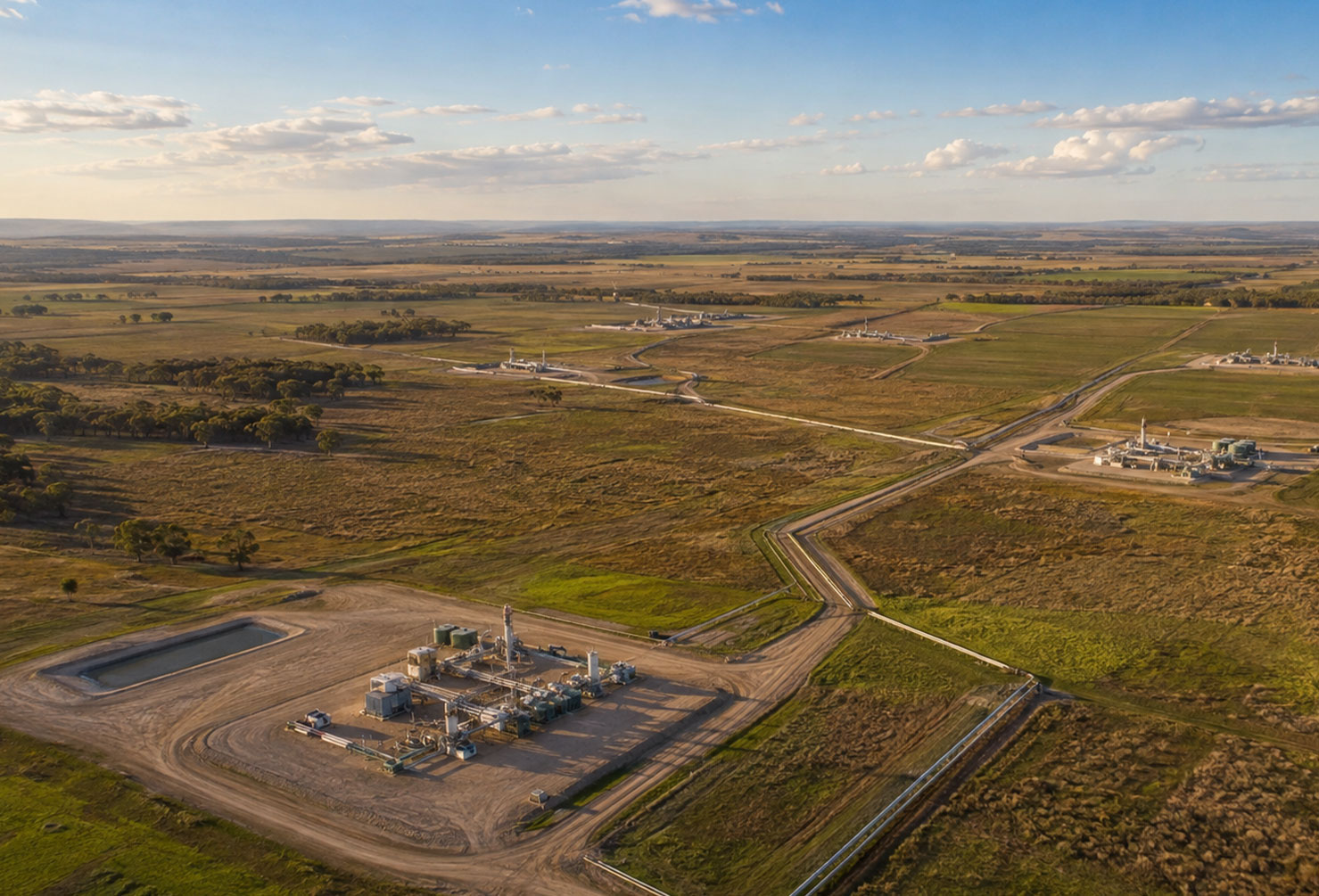
A $713 million investment. 137 new wells across the Wandoan, Chinchilla and Tara areas of Queensland’s Western Downs. First gas expected from 2027 and 2028. Peak production of approximately 84 terajoules per day. Shell’s QGC project plans, revealed this week by Energy News Bulletin, are the latest detail to emerge from what is becoming the most significant CSG development announcement in Queensland in years.
The context matters. This is not a standalone project decision. It is the detailed planning picture behind the Surat Gas Project Central phase that Shell and Arrow Energy announced on 5 August 2026, which involves constructing gas production infrastructure and facilities over a seven-year period. The 137 wells in Wandoan, Chinchilla and Tara represent the planned well count for the areas being developed within that phase, with construction commencing late 2026 and first gas targeted from 2027 through to 2028.
Taken together with the project’s earlier phases, the picture that emerges is of a CSG development program operating at industrial scale across one of Australia’s largest gas tenures. Understanding that cumulative scale, and what it means for the workforce, is worth the effort for anyone operating in Queensland’s upstream sector.
What Is Actually Underway Across the Surat Basin
To understand what the Surat Basin’s workforce story looks like right now, it helps to map the active development phases against their current status:
- Phase 1 (more than 600 wells, Daandine to Tipton area, approved April 2020): operational. First gas delivered in 2021. Arrow has now grown its total workforce to more than 1,000 people since commencing the SGP, including more than 800 roles based in the Surat Basin.
- SGP North (up to 450 wells northeast of Miles, sanctioned August 2024): first gas delivered late 2025 and ramping up. Arrow reported 100 of 250 Stage 1 wells drilled at SGP North as of June 2026. A hybrid gas, solar and battery power station near Miles is expected to become operational in 2027.
- SGP Central (137 wells planned for Wandoan, Chinchilla and Tara areas, $713 million investment, announced 5 August 2026): construction commencing late 2026, first gas targeted from 2027 and 2028, peak production approximately 84 TJ/day.
Three active or recently announced phases. Multiple construction programs running in parallel. A single interconnected gathering, compression and pipeline network tying them together. Arrow’s tenure extends from Wandoan in the north to south-west of Millmerran, spanning seven production licences. The project’s total scope, covering approximately 2,500 wells over its 27-year life, will deliver up to 700 terajoules of gas per day when fully operational, enough to power the equivalent of four million homes.
This is not a sequence of individual projects. It is a coordinated multi-decade development program operating at industrial scale. And the workforce implications of that scale are specific and sustained.
What This Scale of Activity Actually Requires From the Workforce
CSG development at this cumulative scale creates a workforce demand profile that differs materially from a single standalone project. The simultaneous execution of multiple phases across a large tenure area means that workforce requirements are sustained, distributed and overlapping rather than concentrated and cyclical.
The well construction workforce is the largest single demand driver across all phases. With multiple drilling rigs operating simultaneously across the tenure area, each requiring a full crew of drillers, offsiders, derrickmen and mud engineers, the demand is sustained over years rather than concentrated at a single peak. CSG wells in the Surat Basin are drilled to relatively shallow depths of 150 to 750 metres, which means rig cycles are short and crew numbers are maintained over a longer calendar period.
The completions workforce adds to that demand. Each CSG well requires hydraulic fracture stimulation to initiate gas flow from the coal seams. The simultaneous operation of multiple frac fleets across multiple active phases creates sustained demand for completions engineers with specific Surat Basin experience. The stimulation techniques used here are technically distinct from conventional oil and gas well completions, and engineers who understand them are a specialised population.
The surface facilities and compression workforce runs in parallel with well construction. Each new phase requires a field compression station, gathering network pipeline, water and brine infrastructure and road upgrades. The mechanical, electrical, instrumentation and civil trades that build and commission this infrastructure are needed continuously. The SGP North hybrid power station, integrating gas, solar and battery storage, adds a further technical dimension drawing on electrical and power systems professionals beyond the conventional oil and gas skill set.
The operational and maintenance workforce is the long-duration layer. As each phase moves from construction into production, it creates permanent operational employment for production technicians, compression operators, water management specialists, instrument and electrical maintenance personnel and asset integrity professionals. That operational workforce grows with each new phase that comes online and sustains for decades.
The Landowner and Community Workforce — Often Overlooked, Always Critical
One of the most distinctive workforce characteristics of large-scale CSG development in the Western Downs is the landowner and community engagement requirement. Arrow’s tenure covers agricultural land across a vast area. Every well requires negotiated access. Every pipeline requires easement agreements. Every road upgrade requires coordination with local councils and affected landowners.
Arrow CEO Xinmiao Tong specifically called out the landowner dimension in the SGP Central announcement, noting that dozens of landholder agreements are already in place to support the first stages of activity in Warra and southern Brigalow, with further agreements to be built across the project area. That is not incidental language. It reflects a genuine operational constraint that CSG development in Queensland cannot execute without.
Arrow invests approximately $2 million per year in social and community programs across the Western Downs. The professionals who manage those relationships, including landowner liaison officers, community engagement specialists, environmental compliance coordinators and heritage consultants, are among the most operationally critical people on any large CSG program. For workers with agricultural community engagement experience, Indigenous heritage consultation backgrounds or environmental compliance roles in Queensland’s resource sector, the Arrow program represents one of the most sustained sources of employment in the state.
Why the Western Downs Is a Career Destination, Not a Project
The Surat Basin’s workforce story is fundamentally different from the story of a single major project like Scarborough or Barossa. When a construction phase ends on an LNG project, the construction workforce moves to the next opportunity. The Surat Gas Project does not work that way.
Arrow Energy’s 27-year development program means the Western Downs will be an active upstream gas development region from now until the early 2050s. The infrastructure built in Phase 1 supports SGP North. The compression stations commissioned in SGP North handle output from SGP Central. Each new phase does not start from scratch. It extends and densifies an already operational system. Workers who build expertise in Surat Basin operations, whether in well construction, surface facilities, operations or community engagement, are not building single-project experience. They are building career-length expertise in one of Australia’s largest and most durable upstream programs.
For operators and employers planning their workforce strategies, this distinction matters. The workforce that Arrow and its contractors need in the Western Downs is not interchangeable with the construction workforce cycling through WA’s LNG projects. CSG well construction, stimulation, gathering network operation and production optimisation are disciplines that take years of Surat Basin-specific experience to master. The workers who have that experience are a finite and increasingly sought-after population. And with three active or recently announced development phases running simultaneously, competition for them is at its most intense.
The East Coast Gas Picture Behind These Decisions
Arrow’s pace of expansion does not exist in a vacuum. Shell Australia Country Chair Cecile Wake stated that continuing to invest in gas development is critical to domestic energy security, meeting export contracts, and supporting employment and economic activity in regional Queensland. That framing reflects a dual commercial rationale that the current policy environment rewards: the Surat Gas Project’s gas supplies both the QCLNG export terminal on Curtis Island and domestic customers under its 27-year gas sales agreement.
AEMO’s 2026 Gas Statement of Opportunities has identified the period from 2029 as the window of greatest east coast supply risk. Arrow’s SGP Central development, with first gas targeted from 2027 and 2028, is timed directly to that window. The $713 million invested in this phase represents a significant commitment to east coast supply at precisely the moment AEMO says it is needed most.
For the workforce, the practical implication is clear. Arrow is targeting first gas from 2027, which means SGP Central construction commences late 2026. The workforce planning horizon for that program is right now, not when ground breaks. The contractors, service companies and individual workers who will execute these programs need to be identified, verified and engaged before construction begins rather than after it is already running.